|
 Stefanos
Tsivopoulos is a relatively new artist. We
definitely know him as a visual artist, because
his work has been exhibited in spaces where
visual art and exhibitions are presented.
His language, though, as a means he uses in an
almost exclusive way � so exclusive that it
becomes his own - is film, cinema, video,
screenings, the space between darkness and
light, between movement and stability,
performance and enactment, between
specific and alternate timing. Tsivopoulos is
not a film director, in the sense that he
doesn�t make films to be screened in theatres or
on TV, although his works unreel on film and
face the structure of the film. Nevertheless his
works remain suspended between physical, real
and historic space on the one hand and the
conceptual, notional or imaginary space on the
other. In the same sense they suspend between
the architectural space of the exhibition and
the perspective space created by the screening
and this of the visual experience. Their essence
hovers between the beholder and the image thief,
between the image thief and the thief capturing
reality. Stefanos
Tsivopoulos is a relatively new artist. We
definitely know him as a visual artist, because
his work has been exhibited in spaces where
visual art and exhibitions are presented.
His language, though, as a means he uses in an
almost exclusive way � so exclusive that it
becomes his own - is film, cinema, video,
screenings, the space between darkness and
light, between movement and stability,
performance and enactment, between
specific and alternate timing. Tsivopoulos is
not a film director, in the sense that he
doesn�t make films to be screened in theatres or
on TV, although his works unreel on film and
face the structure of the film. Nevertheless his
works remain suspended between physical, real
and historic space on the one hand and the
conceptual, notional or imaginary space on the
other. In the same sense they suspend between
the architectural space of the exhibition and
the perspective space created by the screening
and this of the visual experience. Their essence
hovers between the beholder and the image thief,
between the image thief and the thief capturing
reality.
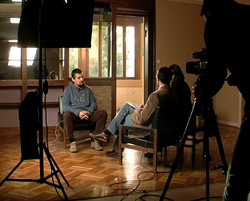 In
the above art works, roles alternate, in a way
that is now typical of his approach, not as a
function incorporated in the evolution or the
writing of a script or fiction, but by
transforming the viewer in the master of the
work, in an active and bewildered writer of his
story and operator of his procedure, while
simultaneously turning the director into a
viewer, whose facts constantly and unexpectedly
change. Who�s watching whom? Who�s pointing
whom? Who talks to whom and who addresses to
whom, are constant questions that the art work
poses with perseverance as a dead-end that
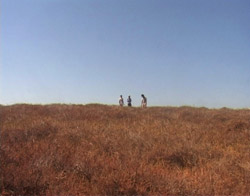
stands before us. Both the artist and the viewer
are on the edge of a cliff, which can even be
real as the case may be (e.g. his work �Land�)
but in all of his works it consists the internal
or basic structure of the work, the
break-through where the work is born and carried
into effect. This cliff is linguistic � as a
break-through in the cinematographic language
itself- as it is spatial � as an image of the
break- through and the function of the rupture
on his work and his writing, as well as inside
the story and its space-. This is obviously the
achievement that gave the artist�s work the
accessibility and recognition it enjoys.
Letting the theory and practice blend in the
work�s and the viewer�s language and space, he
manages to fulfill an entire work on an
abeyance. The ambiguity remains suspended.
It divides or rends, in order to shift its�
hovering position in the abeyance in which our
contemporary civilization waves aside the
relation between speech and image. It�s this
abeyance that Tsivopoulos brings to the
foreground as a break-through, with contemporary
visual, as well as cinematographic, aesthetics
and processes. In
the above art works, roles alternate, in a way
that is now typical of his approach, not as a
function incorporated in the evolution or the
writing of a script or fiction, but by
transforming the viewer in the master of the
work, in an active and bewildered writer of his
story and operator of his procedure, while
simultaneously turning the director into a
viewer, whose facts constantly and unexpectedly
change. Who�s watching whom? Who�s pointing
whom? Who talks to whom and who addresses to
whom, are constant questions that the art work
poses with perseverance as a dead-end that
stands before us. Both the artist and the viewer
are on the edge of a cliff, which can even be
real as the case may be (e.g. his work �Land�)
but in all of his works it consists the internal
or basic structure of the work, the
break-through where the work is born and carried
into effect. This cliff is linguistic � as a
break-through in the cinematographic language
itself- as it is spatial � as an image of the
break- through and the function of the rupture
on his work and his writing, as well as inside
the story and its space-. This is obviously the
achievement that gave the artist�s work the
accessibility and recognition it enjoys.
Letting the theory and practice blend in the
work�s and the viewer�s language and space, he
manages to fulfill an entire work on an
abeyance. The ambiguity remains suspended.
It divides or rends, in order to shift its�
hovering position in the abeyance in which our
contemporary civilization waves aside the
relation between speech and image. It�s this
abeyance that Tsivopoulos brings to the
foreground as a break-through, with contemporary
visual, as well as cinematographic, aesthetics
and processes.
 Fictitiously
or visually as much as constructively or
literary , this abeyance in Tsivopoulos� work is
the subject and reason or to be more precise,
subject and reason are the ones that consist
this abeyance and still remain suspended� In all
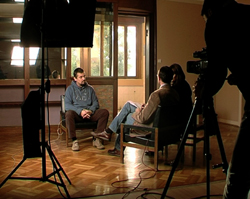
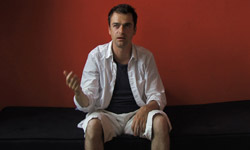
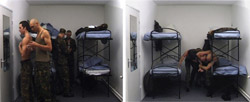
of his works, from Actors (2004) or Stunt
(2005), Land (2006) and Play (2006), Untitled
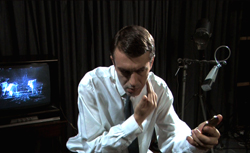
(Remake) (2007) and Interview (2007), to
Untitled (in Plato�s Cave) (2008) and Reverse
(2008), the abeyance always composes the reason
as a break � through while saying and pointing,
decomposes at the same time every standard that
predetermines him, for the film itself as well
as the people, the rhythm, the story, the
fictional line, the space and time, the
narrative and the concept of truth, the function
of speech, the rhetorical figures, its dictum
and its flow, its rhetorical spaces and the
position of the camera as well as the
director�s, the actor�s and the real person, the
viewer, and the viewer�s oration which calls him
or challenges him to stay out of space and time,
on the instant, being part of the process and
retaining consciously suspended the limit of
it�s effectiveness. Fictitiously
or visually as much as constructively or
literary , this abeyance in Tsivopoulos� work is
the subject and reason or to be more precise,
subject and reason are the ones that consist
this abeyance and still remain suspended� In all
of his works, from Actors (2004) or Stunt
(2005), Land (2006) and Play (2006), Untitled
(Remake) (2007) and Interview (2007), to
Untitled (in Plato�s Cave) (2008) and Reverse
(2008), the abeyance always composes the reason
as a break � through while saying and pointing,
decomposes at the same time every standard that
predetermines him, for the film itself as well
as the people, the rhythm, the story, the
fictional line, the space and time, the
narrative and the concept of truth, the function
of speech, the rhetorical figures, its dictum
and its flow, its rhetorical spaces and the
position of the camera as well as the
director�s, the actor�s and the real person, the
viewer, and the viewer�s oration which calls him
or challenges him to stay out of space and time,
on the instant, being part of the process and
retaining consciously suspended the limit of
it�s effectiveness.
 This
suspension Tsivopoulos shares with all the
contributors of each of his works and this
sharing activates, not the small story of the
film, but the large story that carries cinema
and visual arts as an indiscrete unity, that no
commercial or academician protocol can separate.
The relation between cinema and visual arts in
the bottom line is possessed and determined
primarily from the conventions of a chained
production and distribution. It is urgent, to
understand the relation between the �artist�
with the work group or the number of functions
and interventions that characterize the range of
conception, the structure and the unfolding of
the speech that is called �work�. Up to which
degree is the artist able to interfere and
decide the stricture and the realization of the
work in as many levels and practices as possible
that consist it? To which degree does it manage
to reduplicate as a conceptual person and
multiply in a series of physical persons that
construct the entirety of the proposition that
is the work? This is what Tsivopoulos poses as a
question because usually in cinema �and probably
with ways more indirect, but equally binding in
visual arts- despite the fact that the appearing
name is that of the artist�s, the final touch,
call and responsibility belong to the producer. This
suspension Tsivopoulos shares with all the
contributors of each of his works and this
sharing activates, not the small story of the
film, but the large story that carries cinema
and visual arts as an indiscrete unity, that no
commercial or academician protocol can separate.
The relation between cinema and visual arts in
the bottom line is possessed and determined
primarily from the conventions of a chained
production and distribution. It is urgent, to
understand the relation between the �artist�
with the work group or the number of functions
and interventions that characterize the range of
conception, the structure and the unfolding of
the speech that is called �work�. Up to which
degree is the artist able to interfere and
decide the stricture and the realization of the
work in as many levels and practices as possible
that consist it? To which degree does it manage
to reduplicate as a conceptual person and
multiply in a series of physical persons that
construct the entirety of the proposition that
is the work? This is what Tsivopoulos poses as a
question because usually in cinema �and probably
with ways more indirect, but equally binding in
visual arts- despite the fact that the appearing
name is that of the artist�s, the final touch,
call and responsibility belong to the producer.
 But
beyond this sociological differentiation, the fields
that would have allowed more material or technical
differentiations of an artistic specificity of cinema
are rudimentary. Photography and video are
self-existent material means that coexist equally with
film and experimental cinema as they do with visual
arts, the same way speech belongs equally to theater and
literature as in any other human procedure. So, it is
rather hard and pointless for one to search to which
point and with what way the visual is aesthetically
distinguished from the cinematic But
beyond this sociological differentiation, the fields
that would have allowed more material or technical
differentiations of an artistic specificity of cinema
are rudimentary. Photography and video are
self-existent material means that coexist equally with
film and experimental cinema as they do with visual
arts, the same way speech belongs equally to theater and
literature as in any other human procedure. So, it is
rather hard and pointless for one to search to which
point and with what way the visual is aesthetically
distinguished from the cinematic part of the
work. This distinction is not a major concern of
Tsivopoulos�s work and does not rank in a way that
enables one to distinguish the photography, the story,
the narrative and its writing. In most cases, if
something stands out, it is because the viewer gives it
to someone out of the play or if he still remains
inside, acquires its� own dimension and entity from the
moment it means the break-through of speech. The moment
in which we are referring to here, is the one that truth
becomes his own, the viewer�s, inscrutable and
inconceivable from the procedures of the enactment and
whichever technical or artistic ability or script. This
way Tsivοpoulos�s work seems to be defined from Actors
(2004) to the compelling Untitled (Interview) (2008).
Every time, the artist�s role is to break the chain of
meaning regarding the valorization of producing a
meaning and also regarding the value of producing the
work itself, thus putting every immediate perception
within a relative perspective an array of questions,
transfers, destabilizations it entails. And what becomes
a question, transfer, destabilization is exactly that
certainty and effectiveness of these categories, that in
the end, make cinema look more real and direct as a
revealing spectacle or as a documentation of, or as
propaganda tool or as neutral work of art. From one work
to another remains a pendulum between the viewer and the
creator suspended between question and doubt.
 Tsivopoulos
through multiple horizontal and parallel lines
and vertical compressions of different points,
which resonance together, either by position or
nature, systematically and complementarily
composes his work. And his work consists of a
conceptual apperception of that, which either
does not exist at all, or does not exist yet, or
exists only in context as an association, a
hypothesis, an inkling, a suspicion. Therefore
it consists out of either non specific time or
through modifications of the context or the
surrounding space as resonances and assonances.
So what can we say in the approach of a filmic
work, so that we don�t fall in the trap that the
artist so systematically avoids by constantly
separating complexity and entirety? How can one
compound the non specific time and bilocations,
the resonances and the assonances that establish
in a work like the one Tsivopoulos has, combined
with his distinctiveness, his writing and
character? To say that he is better or different
is not essential, even if we believe so. Tsivopoulos
through multiple horizontal and parallel lines
and vertical compressions of different points,
which resonance together, either by position or
nature, systematically and complementarily
composes his work. And his work consists of a
conceptual apperception of that, which either
does not exist at all, or does not exist yet, or
exists only in context as an association, a
hypothesis, an inkling, a suspicion. Therefore
it consists out of either non specific time or
through modifications of the context or the
surrounding space as resonances and assonances.
So what can we say in the approach of a filmic
work, so that we don�t fall in the trap that the
artist so systematically avoids by constantly
separating complexity and entirety? How can one
compound the non specific time and bilocations,
the resonances and the assonances that establish
in a work like the one Tsivopoulos has, combined
with his distinctiveness, his writing and
character? To say that he is better or different
is not essential, even if we believe so.
 We
must underline the consciousness that the truth
does not belong to the artist nor to the work,
but these two combined provoke the viewer and
clear the ground for the truth to stand on its
own. A kind of consciousness that rarely works
anymore and we can see it in Tsivopoulos�s work
as a clear hypostasis of the artist�s speech and
attitude. The tragic question of a society and a
culture where image substitutes speech more and
more, without knowing how and where, when and
why it constists the horizon that activates his
work. This question activates the form of the
work and the substance hypostasis of the speech
through an empty point: the one we called a
cliff in which�s edge we are standing overall as
subjects and objects, suspended. We
must underline the consciousness that the truth
does not belong to the artist nor to the work,
but these two combined provoke the viewer and
clear the ground for the truth to stand on its
own. A kind of consciousness that rarely works
anymore and we can see it in Tsivopoulos�s work
as a clear hypostasis of the artist�s speech and
attitude. The tragic question of a society and a
culture where image substitutes speech more and
more, without knowing how and where, when and
why it constists the horizon that activates his
work. This question activates the form of the
work and the substance hypostasis of the speech
through an empty point: the one we called a
cliff in which�s edge we are standing overall as
subjects and objects, suspended.
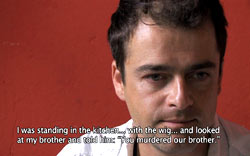 At
the same time we are facing the fracture of
speech and image, its meaning and its recording
within the world. Then Tsivopoulos, by touching
the boundaries of some teachers and friends,
rebels or poets, he touches the crevice, running
over the surface of the mirror. He touches the
fracture that makes truth simultaneously
material reality and something so fragile the
minute you move its new crevices appear in or on
it (it is impossible to distinguish the inside
and the upper side in film or in any image,
memory or speech, place or language). So
this inconceivable moment, when everything can
utter claims to validity and simultaneously
precipitate in the fracture that remains wide
open underneath them as well as inside of them
like an abeyance of the truth, Tsivopoulos
exposes us so unexpectedly. And because, the
truth is not projected but exhibited, his
screenings are cinema as much as they are visual
art and instantly carry the abeyance of the
image between space and time, in a bidirectional
way towards the strains of the break-through. At
the same time we are facing the fracture of
speech and image, its meaning and its recording
within the world. Then Tsivopoulos, by touching
the boundaries of some teachers and friends,
rebels or poets, he touches the crevice, running
over the surface of the mirror. He touches the
fracture that makes truth simultaneously
material reality and something so fragile the
minute you move its new crevices appear in or on
it (it is impossible to distinguish the inside
and the upper side in film or in any image,
memory or speech, place or language). So
this inconceivable moment, when everything can
utter claims to validity and simultaneously
precipitate in the fracture that remains wide
open underneath them as well as inside of them
like an abeyance of the truth, Tsivopoulos
exposes us so unexpectedly. And because, the
truth is not projected but exhibited, his
screenings are cinema as much as they are visual
art and instantly carry the abeyance of the
image between space and time, in a bidirectional
way towards the strains of the break-through.
|