|
|
tributes to
cinema memories,
history,
political & social
issues
every june
in Rodos
Ecofilms |
|
|

|
| Docs
from the archives of War Museum: images of
modern greek history |
|
Ecofilms
�09 welcomes a new collaboration with the War
Museum's film archive.
Each year, rare docs and footage from modern
Greek history will be presented in the
festival's framework.
|
|
|
 WAR
MUSEUM�S FILM ARCHIVE WAR
MUSEUM�S FILM ARCHIVE
A short introduction
The War Museum�s archive was
created in 1979 from films that the Greek Army
owned from the old Armed Forces Television.
After a great survey in Europe
and America, the archive managed to include
everything that was related to Greece from 1897
till 1935. This, combined with the acquisition
of G. Philis� archive, who had done the same
research in depth, offered the archive the
opportunity to obtain everything that took place
in Greece and was filmed during those years. The
most important material is the one that was
offered by individuals that had either been
given it by someone else, or they had filmed it
themselves.
In 1980 the Germans bought all
the news-reel archive of the years 1941-1942
that concerned Greece, as well as a big part of
Italian and British news-reels. This era was
completed with archive material for Kostas
Sismanis� productions for the Museum and the
Armed Forces Television.
The archive also includes
everything about the Cyprus incidents from 1950
and onwards.
All the archive is in 16mm and
35mm film reels and a great effort in
digitalizing it is taking place solely on the
War Museum�s funds.
A big part of the archive
consists of more than 350 taped interviews of
people who took part in these important events
and are still alive.
There is also a very small and
extremely rare audio archive of commentary on
the events of 1904 till 1941. |
|
|
|
Every nation should know and
preserve its roots, traditions and history, as
they are the ones that define its identity. This
need is more imperative in a time when cultural
diversity is threatened by globalization. The
knowledge of a nation�s historical past is
necessary in order to maintain the �flame� of
national consciousness which its existence
depends on.
Especially in Greece, the Greeks�
duty to know the long and chequered history of
their nation is heavy, as they must answer to
the heroes and martyrs that sacrificed their
lives for a free country.
For this reason, the War Musuem
that was inaugurated in July 1975, attempts to
show and teach the solid and continuous in the
centuries, Greek War History. It aspires to
present the course that Hellenism followed from
the moment of its birth till the end of the 20th
century, through the prism of the holy struggle
for the continuum of the Nation.
This archive exists in the
framework of the cultural offer of the War
Museum. It exists from 1979 and includes film
material from 1987 up to this day. These images
are the fruit of the risky efforts of
cinematographers to capture military events,
current politics as well as everyday life
events. Extracts of these will be screened in
Ecofilms 2009.
We hope that Rodos audience will
watch these rare cinematographic extracts. We
are trying to sensitize all those responsible,
as well as artists and young directors on the
importance of film archives. At the same time we
bring out the richness of the War Museum�s
archive that belongs to all Greeks. This rich
archive shouldn�t be in storage but should be
offered to the public and especially the young
generation that must get to know it with every
Konstantinos
Tsimogiannis, Lieutenant General
President of the Board of the
War Museum
|
|
docs |
|
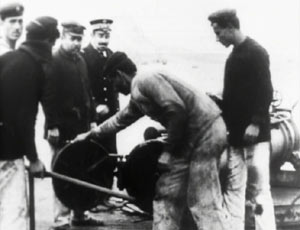 The
Balkan Wars, 10� The
Balkan Wars, 10�
The 1912-1913 period is
characterized by two wars in the Balkan area
that are known as �The Balkan Wars�. The reason
for those was the Balkan nations� desire to free
themselves from the �weak at that point- Ottoman
Empire and form autonomous and independent
nations.
The Naval Battle of Elli
took place in 3-16 of December 1912 and was the
first from the two great battles between the
Hellenic Navy and the Ottoman Fleet during the
First Balkan War and took place in the strait of
the Dardanelles (or Hellespont). The battle
ended with the Hellenic fleet�s victory and the
confinement of the Ottoman in the strait. The
main figures of the battle were the Averof
battleship and admiral Kountouriotis.
The Naval Battle of Limnos
took place in January 5th 1913 and was the
second of the two great battles between the
Hellenic Navy and the Ottoman Fleet during the
First Balkan War and took place in the area of
Limnos Island. The battle ended with the
Hellenic fleet�s victory and the confinement of
the Ottoman in the strait for the following
decades. Footage from both of these naval
battles are presented shot by cameramen who were
on the Greek ships as well as footage from the
areas were these events took place.
|
|
|
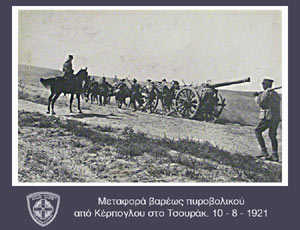 The
War in Asia Minor, 15� The
War in Asia Minor, 15�
Greece, as the winner by
Entente�s side during the World War I, was
rewarded with the concession of several
territories from the Bulgarian and the Ottoman
Empire, countries which during the war had taken
the side of the central forces.
The Arrival of the Greek Forces
In May 15th 1919 the Greek Army
reached Smyrna (İzmir) and took over the city
and the surrounding areas, with the support of
the Greek, French and British navy. At the same
time the Greeks had taken over East Thrace and
Greek and Armenians of Smyrna welcomed them like
saviors. The better part of the Turkish army in
the area surrendered in the allies or escaped in
the countryside. Footage from the arrival of the
Hellenic Army, operations, Turskish captives.
Greek expansion,
In October 1920, the Greek Army
moved in East Asia Minor with the support of the
West that wanted the Turkish government to sign
the Treaty of S�vres. The Greek Forces had a
mission. To defeat the Atat�rk army and force
Turks into negotiations. Footage from the onward
march, Eskişehir and the Greek Army�s life in
Asia Minor.
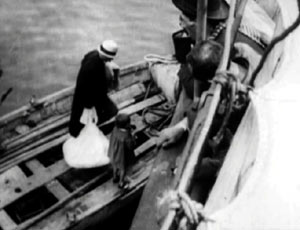 The
End - The Great Fire of Smyrna, The
End - The Great Fire of Smyrna,
The Greek storming parties were
held down in the banks of Sangarius River and a
year later the great Turkish counter-attack took
place (august 1922).
Within a few weeks time, the
Greek Army only owned Smyrna.
The disaster took place from the
13th till the 17th of September 1922 after the
breakaway of the last Greek storming party from
Asia Minor and the onrush of the Kemal Atat�rk�s
guerillas in the city. Atat�rk�s army reached
and conquered Smyrna. In their way in the city,
the Turkish army and the chetas murdered
hundreds of thousands of Greeks, men, women,
even children. Footage from the catastrophe and
the fire in Smyrna. |
|
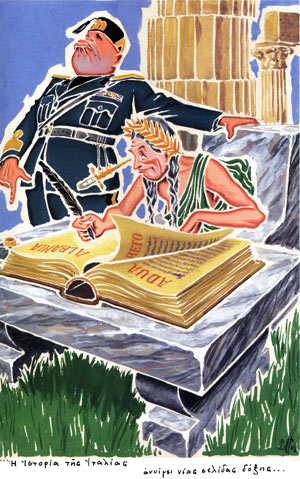 Greco-Italian
War, 7� Greco-Italian
War, 7�
DUCE NARRATES (1942)
By Stamatis L. Polenakis
(1908-1997)
The first Greek animation that S.
Polenakis left us. A unique film inspired by
Benito Mussolini�s pratfalls.
He made this animation during the
Italian occupation in Sifnos Island. Concerning
the creation of it, he narrates:
�After the Germans� onrush in
Athens, I, along with my family went to Sifnos,
in Cyclades, were I originally come from, and
lived in my family�s house. The island was
occupied by the Italians, and there were around
one hundred soldiers there, along with officers,
carabinieri etc.
They went into people�s houses
using various excuses. I had my back covered of
course. First of all, no one else, apart from my
family, knew nothing and secondly, I had a
hiding place right next to me in order to hide
my drawings. As for my colors etc I had an
unfinished landscape next to me.�
|
|
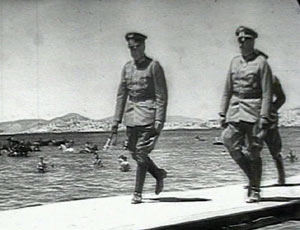 German
Occupation and Greek Resistance, 5� German
Occupation and Greek Resistance, 5�
Footage from the war in the
Aegean Sea and from operation �MERKUR� in Crete
from the German film archive
|
|
|
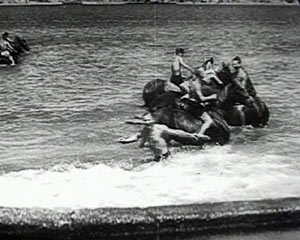 Athens
during the Occupation (footage from the amateur
film of Aggelos Papanastasiou), 10�
Aggelos
Papanastasiou is the first war correspondent of
the Occupation. He bought a small movie camera.
He hid it in a tin box and walked around Athens
in Hospitals, Cemeteries, the market and filmed
images from city life during Occupation.
|
|
|
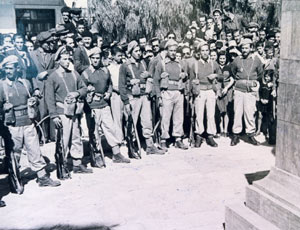 The
Sacred Band of the Middle East, 10� The
Sacred Band of the Middle East, 10�
The Sacred Band was a Greek
�Special Forces Unit� that formed during the
World War II in 1942 in the Middle East, and
consisted from Greek Officers of all three
forces.
Footage from the training and its
action in the Middle East, Libanon and Isma�lia
as well as in the Islands of the Dodecanese is
presented.
|
|
|
Operations in the Aegean � Rigas
Rigopoulos, 15�
Rigas Rigopoulos was a first
lieutenant of the Sacred Band and captain of a
sponge divers� ship which took part in the
operations. As part of the
Anglo-Hellenic Flotilla he
transferred army men and ammunition in the
Aegean and the East Mediterranean with a speed
of 8mph.
�They told us that ours would be
a guerilla war, that we would be pirates. We
would raise the Turkish flag in Turkish waters
and pretend to be fishermen in the German ones�
said Rigopoulos. �One day another captain
conquered a much bigger German ship, jumping on
it like a pirate.
He brought it to us when we were
celebrating Easter, within Turkish waters,
Allah�s watchful eye.� His operations took place
in the islands of the Dodecanese and mainly in
Rodos. |
|
|
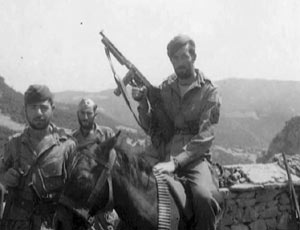 The
action of the 122 Order of the Greek Americans
in the occupied Greece of 1943, 10� The
action of the 122 Order of the Greek Americans
in the occupied Greece of 1943, 10�
The team
of the expatriate guerillas was named 122 Order,
as it was formed 122 years after the Greek
Revolution of 1821.
Peter
Dimosthenis Klenos, the first Greek graduate
from the West Point Military School, became in
charge of the Order and the mission to defeat
the German forces.
His
success was beyond expected.
They are
described in full detail in an archive that was
sealed and remained confidential for many
decades.
Now that
the archive has been opened by the War Museum,
the production of a documentary has already
begun.
|
|
|
|

