|
|
|
Ecofilms' opening stroke a sensitive chord
June 28, 2005
The
international film festival on ecology held each year on the
Greek island of rodos has just changed its name from
Ecocinema to Ecofilms International Film and Visual Arts
Festival. The plural certainly better reflects the diversity
of the lights cast on ecology at this annual event (June
21-26, 2005) which in more than 100 feature films and shorts
from around the world covers a broad range of issues related
to how we protect and nurture human life. In fact, its rich
programming tackles this year classical environmental
subjects, like the management of water resources in The Dream
of Water by Albert Solé from Spain, but also spirituality like
in Monte Grande by Franz Reichle from Switzerland, or
corporate responsibility in A decent Factory by Thomas Balmès
from France, just to mention a few topics and films.
It was
then a clever and bold choice not to open the festival with a
film too explicitly about the environment, stressing in this
manner the plurality of ways we can talk about ecology and
more broadly about the frailty of life.
This film is
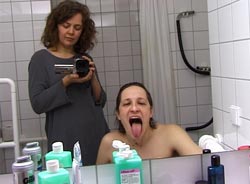
Stroke by Katarina Peters, a personal and extremely moving
story, narrated with a dignity that forces respect. The German
director filmed in DV over 5 years how her husband, the young
and exuberant musician Boris Baberkoff, fought to recover from
a stroke that changed their lives as it caused severe damage
to his brain, impairing his speech, vision and movements.
Their intimacy totally excludes any form of voyeurism or
obscenity that we may have feared if a stranger had filmed the
opus. On the contrary, nothing is dramatized and neither Boris
nor Katarina expresses desperation at any moment, at least in
front of the camera. The filmmaker finds in this feature
something to hold onto when everything seems to fall apart
around her. Somehow, the metaphors she uses suggest she tries
to get as much control as she can over a scenario really in
the crippled hands of her slowly recovering husband. So she
crochets something that turns out to look like a brain with
the threads forming synapses, as if she was trying to rebuild
his mind with her fingers, maybe refering to the Fates of
Greek mythology who would keep him alive as long as some silk
is left. This fallacious sense of control borders on
superstition, as she refuses to film the board at the entrance
of the hospital where Boris is treated because physicians wipe
off the names of their patients as they die. As she actually
cannot control what happens, she ends up reading in her
environment signs of what could happen next. So she observes
every day the frenzied walk of pigeons on the ledge of a
church window, fearing that if one of them fell it would
announce Boris' death, suggesting that she feels some guilt.
Although Boris is the center of the film, the director
definitely ends up as much exposed as him, as he himself tells
her. She is even somehow as much locked in in her own body as
he is. In the end, all the built up tensions overwhelm her in
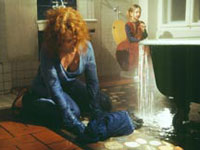
oniric sequences where water floods out of a cello she carved
for her husband over to a room full of guests she seems to
ignore. With these tensions released and the recovery becoming
gradually more complete, the couple finally gets a fresh start
again, as if it all had just been a film.
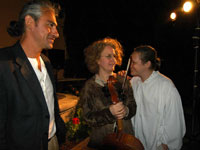
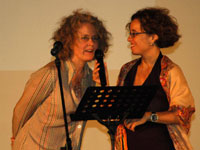
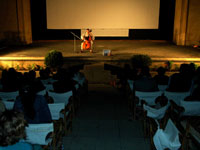
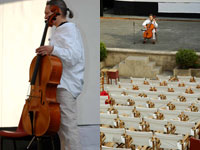
The audience
of the magnificent Rodon open air theater where the feature
was screened definitely strongly connected with this very
personal story as it offered a very long and exceptional
standing ovation to the director and her husband present on
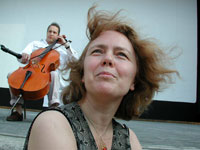
the scene. An affection that grew even more with a cello
recital performed live by a recovering and obviously talented
Boris Baberkoff.
Olivier Delesse
Full
coverage of Ecofilms 2005 on filmfestivals.com :
Ecofilms'
opening stroke a sensitive chord
A
decent factory tackles corporate responsibility at
Ecofilms
Ecofilms
also gives room to short films
Ecofilms
grants a Medwet award for the second year
A
spiritual angle on ecology at Ecofilms
Ecofilms
presents an experimental answer to poverty in
doc
Consumer
society under the spotlight at Ecofilms with Czech
Dream
rodos
Golden Deers
Awards
|
|
|
|
| |



 Search by


