|
|
|
Consumer society under the spotlight at Ecofilms with
Czech Dream
July 3, 2005
Our
consumer society floods us daily with advertising messages
designed to make us buy goods and services manufactured or
provided by companies. But are these messages trustworthy ?
Last year, Ecocinema presented an insight into the inner
workings of the corporate world with The Corporation by Mark
Achbar and Jennifer Abbot. This year Ecofilms, as the
international film festival on ecology held each year in
rodos (Greece) is now known, educates us on how we are
manipulated by advertising as it presents Czech Dream by Filip
Remunda and Vit Klusak.
At the end of their scholarship
in a Czech filmschool, two students decided to make their last
school assignment on advertising. But their project turned out
to be a huge scam that would be talked about all over the
Czech Republic. In a country still freshly converted into a
consumer society, they wanted to prove that advertising
manipulates candid consumers and that people shouldn't take
its messages for gold. So they set up a real-life experiment,
asking a renowned ad agency, Mark/BDDO, to invent for free a
real campaign for a huge hypermarket that didn't exist, their
incentive being that if they could prove they can sell
something that doesn't even exist, it would be a massive
selling point to their paying customers.
The documentary
follows all the steps of the creation and execution of the ad
campaign, from the client briefing, to the finding of the name
of the hypermarket, Czech Dream, the definition of its
promises in focus groups, the makeover of both students into
managers, the making of a price brochure, flyers, press
inserts, bus stop posters, the filming of a TV campaign, the
scoring of a theme song and even the building of the front
wall of the mock hypermarket. All was professionally looking
and professionally made for a cost totalling 300,000 euros on
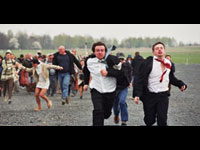
a total film budget of 700,000 euros. Finally 2,000 people
came to the phony opening and the camera cynically filmed
those people running eagerly to the front wall, until they
discovered the scam and turned their anger to both
students.
The experience is original, audacious,
spectacular and fun for the viewer (it is yet also obviously
guilt inducing as the experience is clearly cynical). The film
is quite successful in revealing the inner workings of an ad
campaign, something people unfamiliar with marketing rarely
see. Yet it somehow fails to convince us that ads can sell
anything to unsuspecting and manipulated buyers. In fact, the
campaign was apparently so well conceived that it seemed
impossible not to believe it as all the codes of communication
were skilfully used. Above all, the film obscures the fact
that laws are here to prevent ads from making false promises,
even though they can play on the fringe with ambiguity, and
there is of course a difference between a blatant lie and
ambiguity. So if people follow the ads, it is not because they
are stupid and uneducated, it's because they trust the laws of
their country, and more broadly the contracts our modern
societies are built upon. The message is probably also a
little confused by partisan comparisons made with the campaign
for the EU vote which rolled out at the same moment in the
Czech Republic. However, these legal aspects and the EU
comparison do not diminish the entertaining and informative
values of this energetic documentary.
Olivier
Delesse
Full coverage of Ecofilms 2005 on
filmfestivals.com :
Ecofilms'
opening stroke a sensitive chord
A
decent factory tackles corporate responsibility at
Ecofilms
Ecofilms
also gives room to short films
Ecofilms
grants a Medwet award for the second year
A
spiritual angle on ecology at Ecofilms
Ecofilms
presents an experimental answer to poverty in
doc
Consumer
society under the spotlight at Ecofilms with Czech
Dream
rodos
Golden Deers
Awards
|
|



|
|
| |



 Search by


